Canggu Surfing: A Deep Dive into Canggu vs. Uluwatu for Your Bali Surf Trip
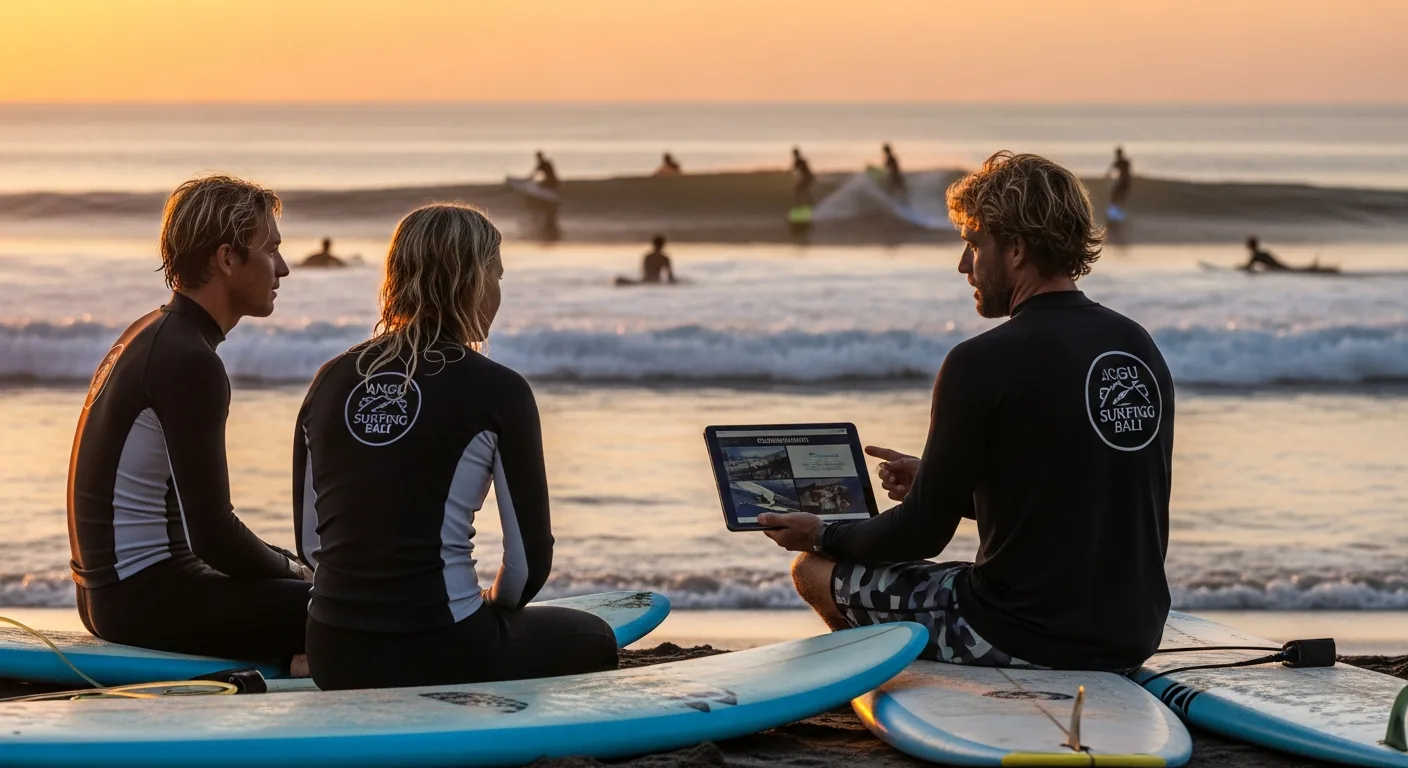
The laptop screen casts a faint glow on your face, illuminating the condensation on a bottle of Bintang. Outside the Canggu café, the late afternoon air is thick with the scent of frangipani and salt. You have a dozen browser tabs open, each a digital breadcrumb in your quest to plan the perfect Bali surf experience. The core of the dilemma is a geographical and philosophical one: Canggu or Uluwatu? One is a sprawling, energetic hub of beach breaks and social life; the other, a peninsula of dramatic cliffs and powerful, world-renowned reef breaks. This decision will define not just where you paddle out, but the entire texture of your time on the Island of the Gods. See also: Contact pricing.
The Great Bali Surf Debate: Canggu’s Approachable Breaks vs. Uluwatu’s Legendary Reefs
Choosing between Canggu and Uluwatu is a foundational decision for any surfer visiting Bali. It’s not merely a choice between two locations separated by 25 kilometers of winding roads—a drive that can take 90 minutes in peak traffic. It is a choice between two distinct surfing ideologies. Canggu, with its collection of sand-and-reef-bottom breaks like Echo Beach, Berawa, and Old Man’s, offers a platform for progression. It’s a place to build skills, experiment with different boards, and integrate surfing into a vibrant, contemporary lifestyle. The surf Canggu Bali scene is characterized by accessibility and variety, making it a fertile ground for those on the learning curve. Uluwatu, on the other hand, is the hallowed ground of Balinese surfing. Its name conjures images of perfectly hollow waves peeling over a sharp, shallow coral reef, a scene first introduced to the world in the iconic 1971 film “Morning of the Earth.” It demands respect, experience, and a certain level of commitment that can be intimidating, if not hazardous, for the uninitiated. See also: see Canggu Surfing’s Home.
Wave Mechanics: Deconstructing the Surf in Canggu and Uluwatu
At a technical level, the waves in these two regions are products of entirely different environments. The primary factor is the sea floor. Canggu’s breaks are predominantly sand-bottomed or a forgiving mix of sand over rock, which creates mellower, more manageable waves. They break in multiple spots along the beach, dispersing crowds and offering a variety of sections. Uluwatu is a different beast. Its waves are shaped by an ancient, live coral reef. This underwater topography is abrupt and unchanging, which causes the Indian Ocean swell to stand up and break with significant power and speed in a very specific location. The tide swing in Bali, which can exceed 2.5 meters, dramatically affects both locations, but the consequences of a miscalculation are far more severe over Uluwatu’s sharp reef at low tide. For a structured approach to your decision, consider this direct comparison: See also: see Canggu Surfing’s About.
| Feature | Canggu (Berawa, Echo, Old Man’s) | Uluwatu (The Peak, Racetracks, Temples) |
|---|---|---|
| Wave Type | Rolling beach breaks, fat and slow-peeling waves | Fast, powerful, often barreling reef breaks |
| Bottom | Sand, volcanic rock, flat reef | Sharp, shallow live coral reef |
| Best Tide | Mid to high tide is generally more forgiving | Mid tide is optimal; low tide is for experts only |
| Entry/Exit | Direct paddle-out from the beach | Paddle through a cave, timed with wave sets |
| Required Equipment | Standard board, leash, wax, rashguard | Board, leash, wax, reef booties (approx. $30 USD) |
| Average Wave Size | 2-5 feet | 4-10+ feet |
Skill Level Breakdown: Where Do You Fit In?
Your current surfing ability is the single most important factor in this decision. Being honest about your skill level not only ensures your safety but also maximizes your enjoyment and progression. The Bali surf experience should be challenging, not terrifying. See also: Surf Spots Canggu pricing.
For the Beginner: Canggu’s Forgiving Sand Bottoms
If you are new to surfing or have only had a few lessons, Canggu is unequivocally your destination. The wave at Old Man’s, named after the nearby temple-like restaurant, is a slow, gentle right-hander that is ideal for learning. Its long, unbroken wave face provides a stable platform for practicing your pop-up and finding your balance. A short scooter ride away, Berawa Beach, which stretches for over 1.5 kilometers, offers numerous peaks that break over sand. This is the perfect environment for a structured lesson, where an instructor can help you understand wave selection and ocean safety in a low-consequence setting. The focus here is on building a solid foundation.
For the Intermediate Surfer: Progression at Echo Beach
Once you are comfortably catching green waves and performing basic turns, Canggu continues to serve as an excellent training ground. Echo Beach presents a step up in quality and power. It has a main left-hand reef/sand break and a faster right-hander known as the “Sandbar.” These waves offer more vertical faces, allowing you to practice generating speed and executing more committed maneuvers. The beauty of the canggu surf scene is this built-in progression. You can start your trip at Old Man’s and, as your confidence grows, graduate to the more challenging waves at Echo Beach, all within a few kilometers. This is where our intermediate-level canggu surf lessons, which can include video analysis, become invaluable for refining technique.
For the Advanced: Uluwatu’s Demanding Arena
Uluwatu is the domain of the confident and experienced surfer. The entry alone, a paddle out from a cave at the base of the cliff, requires precise timing and ocean awareness. Once in the lineup, you’re contending with powerful swells, strong currents, and a crowd of highly skilled surfers. The waves—from The Peak’s shifting take-off zone to Racetracks’ high-speed sections—break with force over a reef that is unforgiving of mistakes. While it offers the ride of a lifetime for those who are prepared, it is not a place for learning or hesitation.
The Culture and Vibe: Beyond the Waves
The surf is only part of the equation. The atmosphere on land shapes your experience just as much as the conditions in the water. Canggu is a dynamic, international hub. Since 2019, its population has seen substantial growth, driven by a community of digital nomads, wellness practitioners, and creative entrepreneurs. The streets are lined with specialty coffee shops, design-forward boutiques, and restaurants offering everything from vegan tasting menus to traditional Balinese fare. The vibe is social and energetic. After a surf session, you might find yourself at a yoga class, a co-working space, or a sunset session at a beach club like The Lawn. The focus is on a balanced, connected lifestyle where surfing is a key component, but not the only one.
Uluwatu, perched on the limestone cliffs of the Bukit Peninsula, cultivates a different sensibility. The pace is slower, the atmosphere more contemplative. The area is defined by its dramatic geography and its deep connection to both surf history and Balinese spirituality, exemplified by the 11th-century Pura Luhur Uluwatu temple. The social scene revolves almost entirely around surfing. Conversations at clifftop warungs are about swell charts and tide times. The evenings are spent at institutions like Single Fin, watching the sun dip below the horizon as the last sets of the day roll in. It’s a purer, more focused surf existence, appealing to those who want to disconnect and immerse themselves fully in the ocean’s rhythm.
Logistics and Costs: A Practical Comparison
“From a travel planning perspective, the choice impacts your budget and daily logistics significantly,” notes Isabelle Dubois, a surf travel consultant who has logged over 300 days in Bali since 2015. “Canggu is built for convenience and offers a wider range of options at various price points. Uluwatu can be more expensive, particularly for cliffside accommodation, and requires more planning as amenities are more spread out.” A typical daily budget can vary widely, but a general comparison highlights Canggu’s value, especially for those booking multiple lessons or extended rentals.
- Surf Lessons: A 2-hour private lesson in Canggu with an established school like Canggu Surfing is approximately $50-70 USD. A similar lesson in Uluwatu, often focused on reef guiding rather than beginner instruction, can start at $80 USD.
- Board Rental: A quality board rental in Canggu costs around $7-10 USD for 2 hours or $20 USD for a full day. In Uluwatu, daily rentals for high-performance boards are closer to $25-30 USD.
- Accommodation: Canggu offers a vast inventory of guesthouses, villas, and hotels, with comfortable private rooms available from $40 USD per night. In Uluwatu, desirable cliff-front properties often start at over $150 USD per night.
- Food & Drink: A meal at a mid-range restaurant in Canggu can cost $10-15 USD. A Bintang beer at a Berawa warung is about 35,000 IDR (~$2.25 USD). In Uluwatu, dining at a popular cliff club can easily exceed $40 USD per person.
- Transportation: In both areas, a scooter rental is the most efficient way to get around, costing about $5 USD per day.
Expert Analysis: Why Canggu is the Superior Choice for Progression
While the allure of Uluwatu is undeniable, for the vast majority of surfers—from first-timers to solid intermediates—Canggu provides a superior environment for improving your skills. “The most important thing for learning is repetition,” says Wayan Sudira, a lead instructor at Canggu Surfing with over 15 years of coaching experience. “In Canggu, you can catch ten, fifteen, twenty waves in a session. You can fall, try again, and not worry about hitting a sharp reef. This builds muscle memory and confidence much faster. At Uluwatu, you might wait 30 minutes for one wave, and the fear of the reef can make you hesitate.”
Learning on sand is a strategic advantage. It allows you to focus purely on the mechanics of surfing—paddling, positioning, pop-up, and turning—without the added mental load of navigating a hazardous bottom. This safe environment accelerates the learning curve. When you plan to surf Canggu Bali, you are investing in a platform designed for sustainable improvement. You can take a lesson in the morning, rent a board to practice on your own in the afternoon, and receive feedback from a local community of supportive surfers. This ecosystem of learning and practice is the defining feature of the Canggu surf experience.
Your Canggu Surf Itinerary: Lessons and Rentals with Canggu Surfing
Having established Canggu as the logical choice for your surf development, the next step is to engage with the best resources available. At Canggu Surfing, established in 2018, we have tailored our programs specifically for beginner and intermediate surfers looking to make tangible progress during their time in Bali. Our team of local instructors possesses a combined 50+ years of experience surfing these exact breaks. We don’t just push you into waves; we provide a framework for understanding the ocean.
Private Canggu Surf Lessons
Our one-on-one lessons are the fastest way to advance. Each two-hour session includes on-land theory, safety instruction, and in-water coaching focused on your specific goals. We cover everything from the fundamentals of the pop-up to the nuances of wave selection at Echo Beach. We provide the board, rashguard, and expert guidance. All you need is the desire to improve. A private lesson begins at $65 USD.
Premium Canggu Surf Rental
For those who prefer to surf independently, our extensive quiver of rental boards offers something for every skill level. From stable, high-volume soft-tops for beginners to performance mid-lengths and shortboards for intermediates, our boards are meticulously maintained. Our staff will help you select the right board for the day’s conditions and your ability, ensuring you have the best possible equipment under your feet. Rentals start at $10 USD for two hours.
The debate is settled. For a surf trip defined by progress, enjoyment, and a rich cultural experience, Canggu is the clear choice. Let us handle the details. Contact Canggu Surfing to book your lessons or reserve your board, and turn your plan into a reality.
Brand: Canggu Surfing
Phone: +62 (811) 394-14563
Email: [email protected]
Office: Jalan Sunset Road No. 88, Kuta, Badung, Bali 80361